Razer Carbon Fiber Collection: 47g Viper, 49g DeathAdder, Specs and Whether $250 Is Worth It
Razer has put real woven carbon fiber shells on its two flagship esports mice. Here are the official weights, sensors and battery claims, what outlets say they cost, and who should actually consider one.
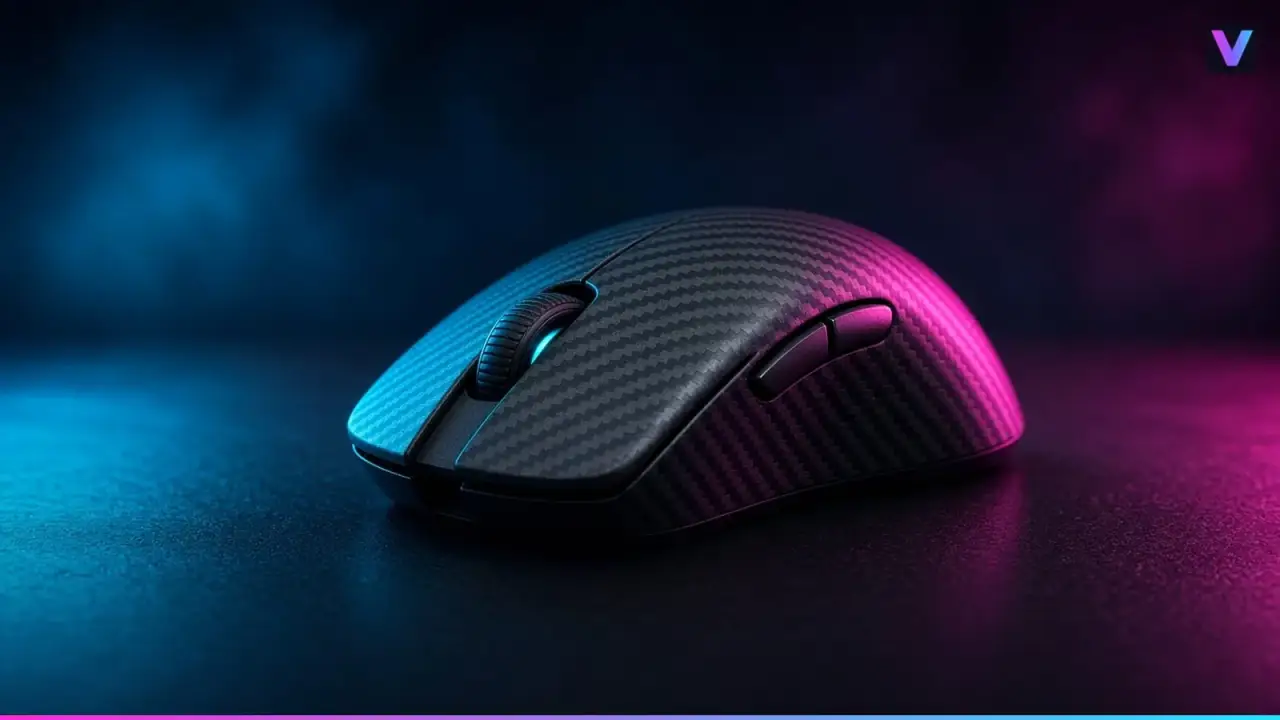
The Razer Carbon Fiber Collection is official. On 17 November 2026, Razer’s newsroom announced two new wireless esports mice: the Razer Viper V4 Pro Carbon Fiber Edition and the Razer DeathAdder V4 Pro Carbon Fiber Edition. These are not painted special editions. Razer says it has rebuilt the shells in real woven carbon fiber, then left the weave visible under a clear UV-cured coating.
If you already like the standard Viper or DeathAdder shape, that is the point. The company is selling the same silhouettes, made from a different material, at a much higher price than the regular models. KitGuru and Final Weapon both report a price of $249.99 / £249.99. Razer itself has not put a price in the newsroom post, so we are treating that figure as reported rather than as a number we can quote from the company.
 SHORT
Key facts
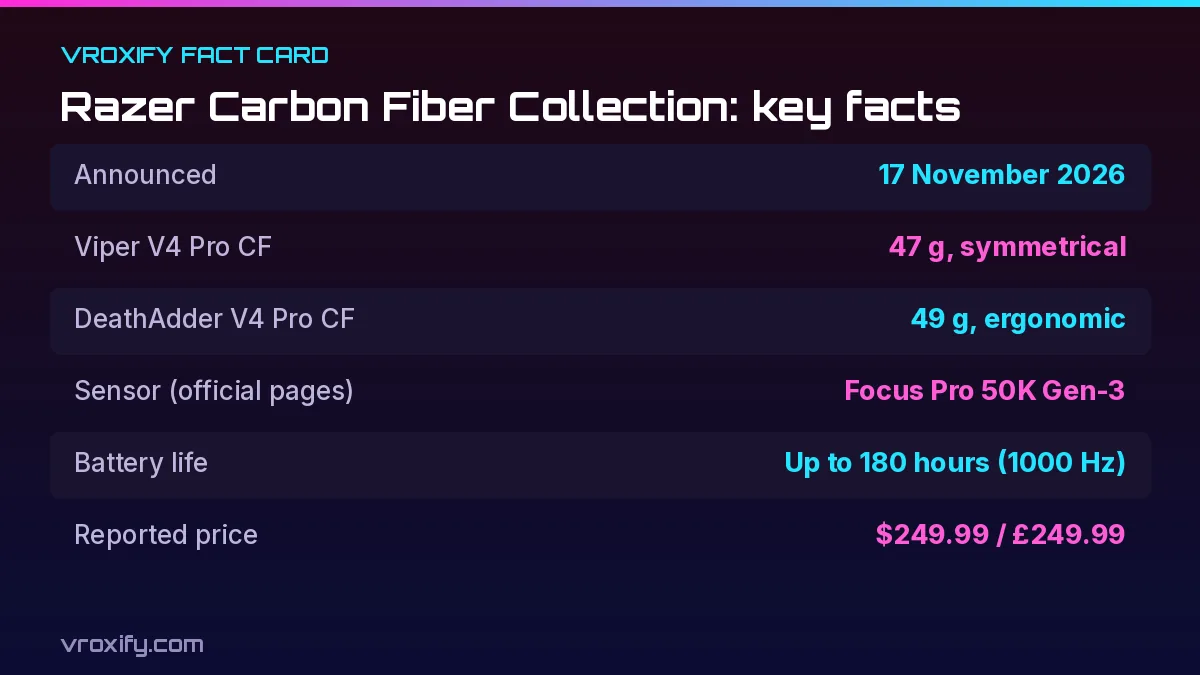
- What launched: the Razer Carbon Fiber Collection, announced 17 November 2026 (Razer Newsroom)
- Viper V4 Pro Carbon Fiber Edition: 47 g, symmetrical shape, official product page here
- DeathAdder V4 Pro Carbon Fiber Edition: 49 g, right-handed ergonomic shape, official product page here
- Shell: 2×2 twill woven carbon fiber, hot-pressed, CNC-cut, clear UV-cured coat; Razer says carbon fiber makes up 40% of each mouse
- Strength claim: up to 53% stronger than ABS plastic, from Razer’s internal testing
- Reported price: $249.99 / £249.99, from 17 November, via KitGuru and Final Weapon
What Razer actually changed in the Razer Carbon Fiber Collection
The useful way to read the Razer Carbon Fiber Collection is to separate the material from the electronics.
On the material side, the Razer Carbon Fiber Collection is specific. The company says the fiber is woven in a 2×2 twill, the sheets are hot-pressed and cured under heat and pressure, then CNC machinery cuts each shell to the existing Viper or DeathAdder contours. The shells are not painted. A clear UV-cured coating is applied so the weave stays visible. Charlie Bolton, Razer’s Global Head of Design, said the team “kept the shapes pros trust and rebuilt the shell in real carbon fiber,” and that “with no paint to hide behind, every stage had to be exact.”
Razer also says carbon fiber makes up 40% of each mouse, and that the finished shell is up to 53% stronger than ABS plastic. That second figure is the company’s own laboratory claim. It is not an independent test. It may be true, but you should treat it as a manufacturer result until a lab or reviewer repeats it.
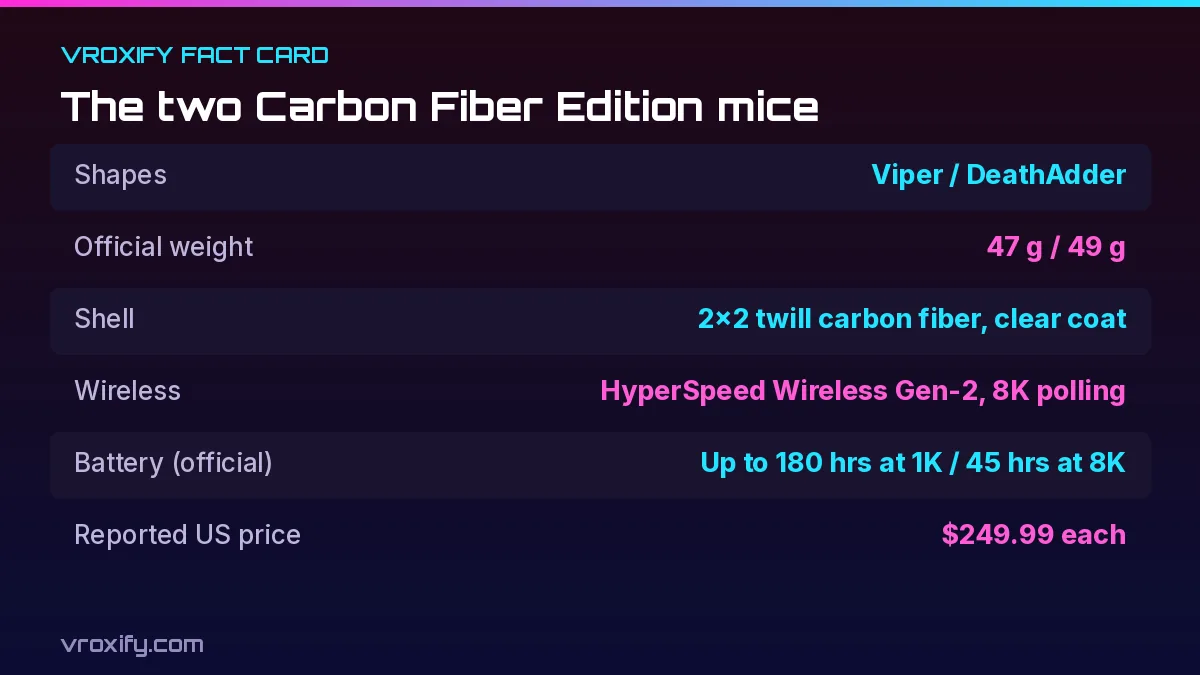
On the electronics side, the newsroom says both mice use the Razer Focus Pro 50K Optical Sensor Gen-3, HyperSpeed Wireless Gen-2 and Optical Mouse Switches Gen-4, with up to 180 hours of battery life. The official Viper and DeathAdder product pages both repeat a 50K DPI, 930 IPS and 90 G sensor claim, and both list battery life of up to 180 hours at 1000 Hz, or up to 45 hours at 8000 Hz. The Viper page also says HyperSpeed Wireless Gen-2 supports true 8000 Hz polling.
That last point matters if you are coming from an older DeathAdder V4 Pro. The newsroom says the Carbon Fiber DeathAdder includes “a sensor and battery life upgrade from the base model.” In other words, this is not only a cosmetic shell for the ergonomic mouse. The Viper Carbon Fiber Edition, by contrast, is described as carrying over the current Viper V4 Pro’s performance and changing the shell and weight.
One caution: Razer’s same-day blog post describes the DeathAdder edition as using a Focus Pro 45K sensor, which contradicts the newsroom and both product pages. We are going with the product pages and the newsroom, and flagging the blog line as inconsistent. If you buy one, check the box and the listed specs on the product page at checkout.
How light is the Razer Carbon Fiber Collection, and does the weight matter?
Razer lists the Viper V4 Pro Carbon Fiber Edition at 47 g and the DeathAdder V4 Pro Carbon Fiber Edition at 49 g. Those official weights are the clearest measurable change in the Razer Carbon Fiber Collection.
For competitive FPS players, a couple of grams is not a novelty. It is the kind of difference people already argue about on mouse pads and aftermarket bases. A lighter shell can make flicks start and stop with less effort, especially in long sessions. It can also make a mouse feel cheaper or less planted if the shape flexes or the balance is off. Razer is arguing that carbon fiber lets it cut weight without losing rigidity. That is a reasonable engineering pitch. It is also something you can only verify by using the mouse, or by waiting for independent flex and click tests.
The company has already lined up familiar names to talk about the feel. VALORANT player Jaccob “Zellsis” Whiteaker, quoted in the newsroom, said it is “the Viper shape I already love, and the carbon fiber makes it feel stronger and more premium.” CS player Nikola “NiKo” Kovač said the DeathAdder version “feels a lot more premium and stronger” and is “noticeably lighter.” Those are endorsements, not measurements. They tell you the shapes have not been redesigned underneath the new material.
If you already own a standard Viper V4 Pro or DeathAdder V4 Pro and like it, the Razer Carbon Fiber Collection is a material and weight upgrade, not a new shape to re-learn. If you have never got on with either silhouette, a $250 shell will not fix that.
How much does the Razer Carbon Fiber Collection cost, and is it official?
Razer has not included a price in its newsroom announcement or in the blog post. Two outlets that wrote up the launch the same day do give a number.
KitGuru says both mice “will be available from 17th November, priced at £249.99/$249.99.” Final Weapon reports the same $249.99 US price, says both are sold exclusively through Razer.com and RazerStores, and adds a distinction we have not seen in Razer’s own copy: it says the DeathAdder edition is available to order now, while the Viper edition can be pre-ordered. Until Razer states that clearly on the product pages, treat the pre-order split as Final Weapon’s reporting, not as a confirmed company line.
Either way, this is expensive. A quarter of a thousand dollars for a mouse puts the Razer Carbon Fiber Collection above most flagship wireless mice, and it is the main reason to hesitate on the Razer Carbon Fiber Collection, including Razer’s own standard Viper and DeathAdder models. You are paying for a visible carbon-fiber shell, a slightly lower weight and, on the DeathAdder, a claimed sensor and battery bump. You are not paying for a new sensor family on the Viper, and you are not getting a new shape.
If the reported price is accurate where you live, the honest question is not “is carbon fiber cool?” It is “do I want this material and weight enough to spend a mid-range GPU’s leftover cash on a mouse?” For most people, the answer should be no. For a small group of competitive players who already live in the Viper or DeathAdder shape and care about every gram, it is at least a coherent product, which is more than you can say for many special editions.
Also watch for regional pricing quirks. KitGuru quotes the same 249.99 figure in pounds and dollars, which is rarely a good deal for UK buyers once you compare it with typical US-to-UK conversion. Confirm the live checkout price on Razer’s local store before you assume the headline number.
Should you buy the Razer Carbon Fiber Collection, or keep a standard Viper or DeathAdder?
Here is a straightforward way to decide.
Buy, or at least seriously consider, a Carbon Fiber Edition if: you already prefer the Viper or DeathAdder shape, you want the lightest official version of that shape, you like the exposed weave, and the reported $249.99 / £249.99 price is money you are comfortable spending on a peripheral. The DeathAdder edition is the stronger “upgrade” story, because Razer says it also improves the sensor and battery life over the base model.
Skip the Razer Carbon Fiber Collection, or wait for reviews, if: you do not already love the shape, you are happy with a standard Viper V4 Pro or DeathAdder V4 Pro, or you would rather put that money toward a graphics card or a budget PC build that will change how games actually look and run. A mouse shell will not fix a GPU or memory bottleneck, and this is a bad week to pretend otherwise, with higher memory and system prices still hanging over consumer PCs.
Wait for third-party tests if: you care about the 53% strength claim, click consistency, wireless interference, or whether the clear coat stays clean after a month of sweaty sessions. None of those has been independently verified in the write-ups published so far.
If you do buy one, buy it from Razer or a retailer you can return to. At this price, a coating issue or a sensor dud is not something you want to argue about on a marketplace listing.
What the Razer Carbon Fiber Collection says about high-end PC peripherals
The Razer Carbon Fiber Collection is part of a wider shift. Flagship mice have been getting lighter, stiffer and more expensive for years, and materials that used to be marketing wallpaper — magnesium, carbon fiber, foam — are now the actual product story. That can be good, when the material does something measurable. It can also become a way to sell the same internals twice.
Razer’s version of that story is more serious than a colourway. A woven, CNC-cut, unpainted shell is a real manufacturing change. The risk is the price, not the idea. If reviewers later show a stiffer shell and a cleaner 47 g Viper, the collection will make sense for a niche. If they show a finish that wears badly, or performance that is identical to a much cheaper standard model, it will look like a luxury tax.
Until those reviews land, the official facts about the Razer Carbon Fiber Collection are simple: two familiar shapes, official weights of 47 g and 49 g, official 50K sensor and 180-hour battery claims, and a reported price of $249.99 / £249.99. That is enough to decide whether you are in the market. It is not enough to crown either mouse the new default recommendation.
For other recent PC hardware context, see our guides to the Intel Core Ultra 7 260K and RTX Spark laptops. We will update this article if Razer posts an official price, clarifies the DeathAdder sensor line, or if independent tests contradict the strength or battery claims.
FAQ
What is included in the Razer Carbon Fiber Collection?
It is Razer’s 17 November 2026 launch of two wireless esports mice with woven carbon-fiber shells: the Viper V4 Pro Carbon Fiber Edition and the DeathAdder V4 Pro Carbon Fiber Edition.
How much does the Razer Viper V4 Pro Carbon Fiber weigh?
Razer lists the Viper V4 Pro Carbon Fiber Edition at 47 g and the DeathAdder V4 Pro Carbon Fiber Edition at 49 g.
How much do the Carbon Fiber Edition mice cost?
Razer has not printed a price in its newsroom post. KitGuru and Final Weapon both report $249.99 / £249.99, with sales through Razer.com and RazerStores. Confirm the live price on Razer’s store before buying.
Do both mice use the same sensor?
Razer’s newsroom and both official product pages say they use the Focus Pro 50K Optical Sensor Gen-3. The company also says the DeathAdder Carbon Fiber Edition upgrades the sensor and battery life compared with the base DeathAdder V4 Pro. A same-day Razer blog post mentioned a 45K sensor on the DeathAdder edition, which does not match the product pages.
Is the carbon-fiber shell stronger than plastic?
Razer says internal testing found the shell is up to 53% stronger than ABS plastic. That is a company result, not an independent lab test.
Should I replace a standard mouse with the Razer Carbon Fiber Collection?
Only if you want the lighter official shell and you are comfortable with the reported $250 price. The shapes are the same. Most people will be better served by keeping the standard model.
Sources
- Razer Newsroom (17 Nov 2026): Razer unveils the Carbon Fiber Collection
- Razer: Viper V4 Pro Carbon Fiber Edition product page
- Razer: DeathAdder V4 Pro Carbon Fiber Edition product page
- Razer blog (17 Nov 2026): Carbon Fiber Perfected
- KitGuru (17 Nov 2026): Razer goes carbon fibre with new Viper V4 Pro and DeathAdder V4 Pro variants
- Final Weapon (17 Nov 2026): Razer launches Carbon Fiber Editions of the Viper V4 Pro and DeathAdder V4 Pro
Checked on 18 November 2026. Prices are attributed to named outlets because Razer did not include MSRP in its newsroom post. Vroxify is not affiliated with Razer. Artwork is original and does not use official product photography or logos.
Related articles

Gears of War E-Day SSD Test: Why NVMe Saves 2GB of RAM and When SATA Hurts
Gears of War E-Day SSD streaming explained: Tom's Hardware measured up to 3.7 GB/s reads and about 2GB of RAM saved on NVMe. What it means for 16GB PCs, SATA owners and your next upgrade.

AMD Adrenalin 26.11.1 Fixes the Radeon SSD Write Bug: Who Needs It and How to Update Safely
AMD Adrenalin 26.11.1 explained: the atieclxx.exe SSD write bug, which Radeon cards were affected, how to check your PC, how to install the fix cleanly, which workarounds to undo, and the known issues to watch.

Xbox Game Pass Wave 2: High on Life 2, The Outlast Trials and Every Date in the November Lineup
Xbox Game Pass wave 2 for November 2026 includes Paw Patrol: Dino World, High on Life 2, Call of the Elder Gods, The Outlast Trials and Hela: of Mice and Magic. Dates, Game Pass tiers and the eight games leaving on 30 November.