Jensen Huang Resigns as NVIDIA CEO: What It Means for GeForce Gamers
NVIDIA has now published its first results since Jensen Huang resigned. Revenue rose 103% to $115.8 billion, and board chair Harvey Jones said the company does not intend to reinstate him as CEO. Here is what that means for GeForce owners.
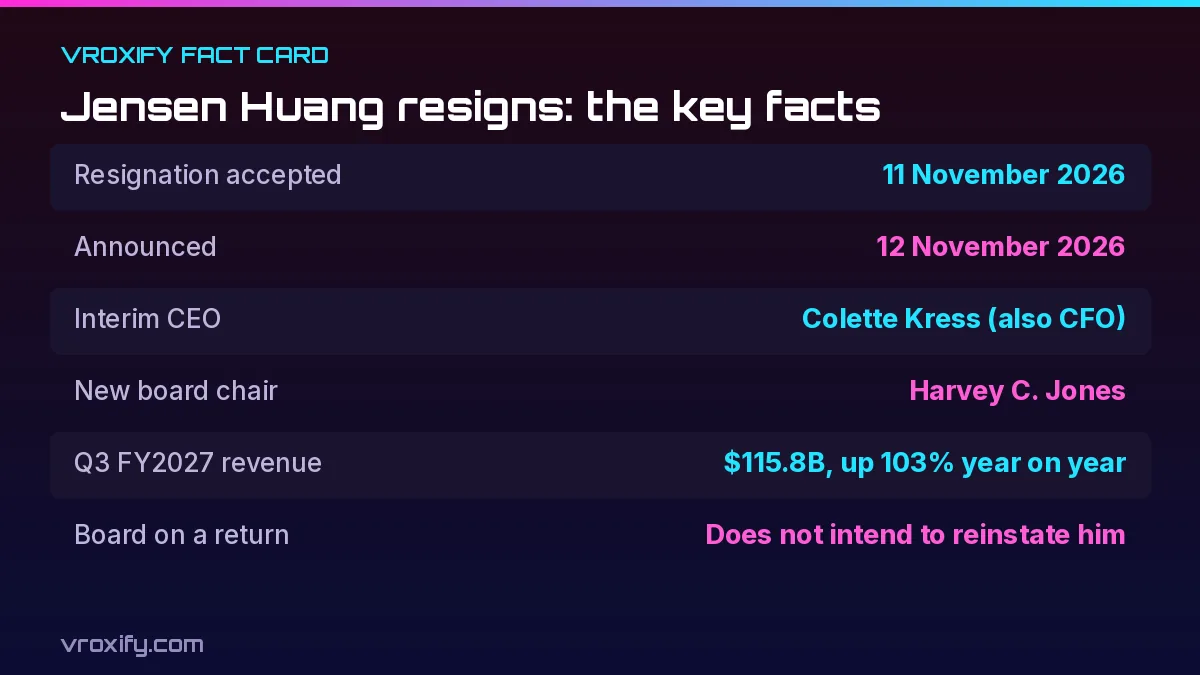
Jensen Huang resigns as NVIDIA’s president, chief executive and board member, ending a 33-year run at the company he co-founded. NVIDIA’s board accepted the resignation on 11 November 2026, effective immediately, according to the company’s filing with the US Securities and Exchange Commission, and announced it the next day. Chief financial officer Colette Kress is now interim CEO while the board searches for a permanent successor.
Updated 18 November 2026: NVIDIA has published its third-quarter fiscal 2027 results. Interim CEO Colette Kress reported record revenue and said the product roadmap is on track. On the earnings call, board chair Harvey Jones said the board does not intend to reinstate Jensen Huang as CEO, according to Al Jazeera and CBC News, which published a Reuters report. The new figures and what they mean for GeForce owners are in the update section below.
For PC gamers, the obvious question is whether any of this touches the graphics card in your PC or the one you planned to buy. This article separates what NVIDIA has confirmed from what has only been reported, and explains what it means for GeForce owners in practical terms.
 SHORT
Key facts
- What happened: Jensen Huang resigned as President, CEO and board member, effective immediately (NVIDIA Newsroom)
- When: the board accepted the resignation on 11 November 2026 (SEC filing)
- Interim CEO: Colette Kress, who stays on as CFO
- Chair of the board: Harvey C. Jones, NVIDIA’s first-ever board chair
- Q3 FY2027 results (17 Nov): revenue of $115.8 billion, up 103% from a year ago (NVIDIA Newsroom)
- Graphics segment: $9.8 billion, up 62% from a year ago (CFO commentary)
- Consumer PCs: NVIDIA says higher memory and system prices continue to affect demand
- Board on a return: chair Harvey Jones said the board unanimously accepted the resignation and does not intend to reinstate Huang as CEO, as reported by Al Jazeera and CBC News
Why Jensen Huang resigned: what is confirmed and what is reported
NVIDIA’s own announcement is brief. It says Huang resigned and thanks him for building the company, but it does not give a reason. The reasons come from news reporting, and it is important to keep the two apart.
According to NPR and ABC News, the board had opened an investigation after reports in The New York Times about Huang’s personal relationships, including one with a business associate whom, according to the Times, US intelligence officials believed had been recruited by China. NPR reports that Huang acknowledged an extramarital affair in an email to staff and said he would cooperate with the investigation.
ABC reports that Beijing has denied the spying allegations, and that NVIDIA said it had “no reason to believe” national security or NVIDIA secrets were compromised. Neither NPR nor ABC independently confirmed the Times’ intelligence claims. We are reporting what those outlets published, with attribution, and we will not speculate beyond it.
What NVIDIA has said about the business
The board’s statement focuses on continuity. It says the company has “an experienced leadership team” and that it expects “the company’s operations, customer commitments and product roadmap to continue without interruption.” In other words, NVIDIA is telling customers, partners and investors that nothing about its products changes because of the leadership change.
Timeline: how the week unfolded
| Date (2026) | Event |
|---|---|
| Before November | Jensen Huang says in an interview that he hopes the next NVIDIA CEO is “already at the company” (as quoted by NPR) |
| 16 October | RTX Spark laptops go on sale, one of the last big consumer launches under Jensen Huang |
| Early November | The New York Times reports on Jensen Huang’s personal relationships; the board opens an investigation (as reported by NPR) |
| 11 November | The board accepts Jensen Huang’s resignation, effective immediately, and names Colette Kress interim CEO |
| 12 November | NVIDIA publishes the announcement; Harvey C. Jones becomes board chair |
| 17 November | Q3 FY2027 results: $115.8 billion revenue; Jones says the board does not intend to reinstate Huang |
Who is Colette Kress?
Colette Kress has been NVIDIA’s executive vice president and chief financial officer since 2013. According to TechCrunch, she previously spent three years as a senior finance executive at Cisco and 13 years at Microsoft, including four years as CFO of its Server and Tools division.
She will hold both roles, interim CEO and CFO, until a permanent CEO is named. The board also appointed Harvey C. Jones as its first-ever chair. The SEC filing says Jones, 73, has served on NVIDIA’s board since 1993, including time as CEO and executive chairman of Synopsys.
What it means for GeForce gamers
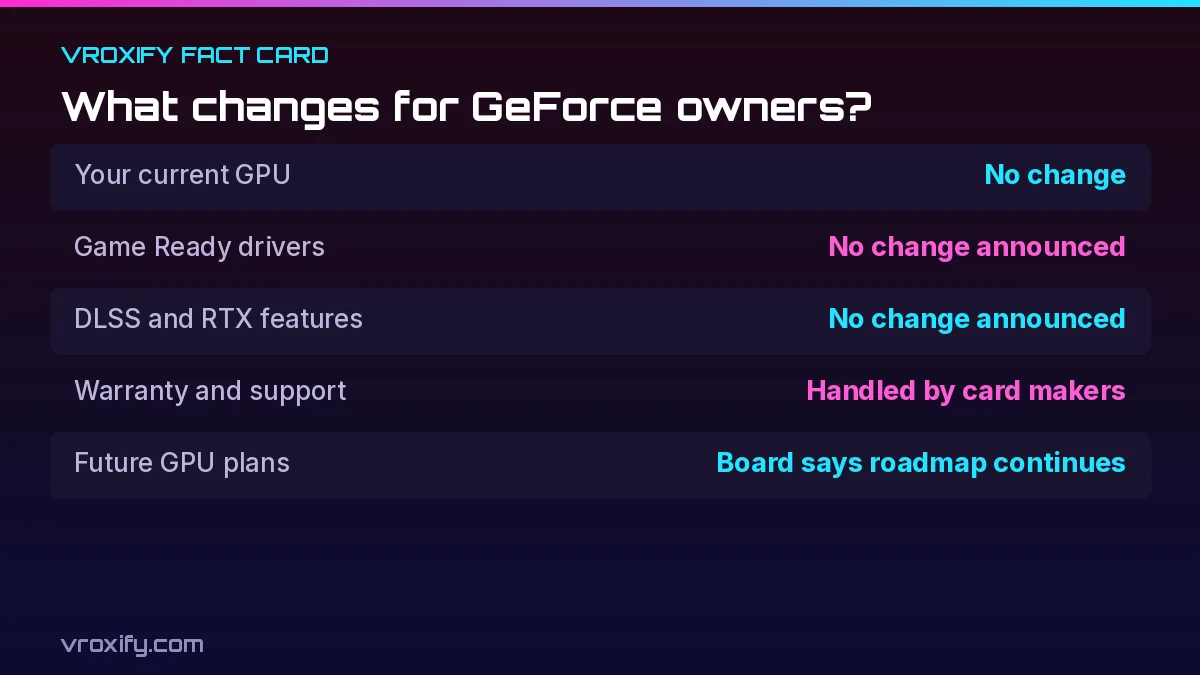
Here is the practical part. A change at the top of a company does not change the hardware you already own, and NVIDIA has not announced any change to its consumer products.
- Your current graphics card works exactly as before. Nothing about a GPU’s hardware or licence depends on who runs the company.
- Game Ready drivers, DLSS and RTX features. NVIDIA has not announced any change to driver releases or consumer features, and Kress later said the product roadmap is on track.
- Warranty and repairs. Most GeForce cards are sold by partner brands, which handle warranty claims. That does not change.
- Future GPUs. The board says the product roadmap continues “without interruption.” That is a statement of intent, repeated in the 17 November results, not a new product announcement.
Will graphics card prices change?
There is no announcement that would move prices directly because of the CEO change. Graphics card prices in late 2026 are shaped mainly by supply and demand, especially the memory shortage driven by AI data centres, which we cover in our best graphics card for 1440p guide. In its 17 November results, NVIDIA itself said higher memory and system prices continue to affect consumer PC demand. If anything moves prices in the short term, it is more likely to be those costs and the usual Black Friday promotions than the leadership news.
Our advice is unchanged: decide your resolution, set a price ceiling relative to the card’s launch price, and buy when you find a deal under it. There is no product reason to delay a fair-priced GPU just because the CEO changed. Our budget gaming PC build guide explains how to plan around the current shortage.
RTX Spark laptops, on sale since 16 October, are still sold and supported by the laptop makers. NVIDIA has not announced any change to that platform; see our RTX Spark laptops guide. The Nintendo Switch 2 uses a custom NVIDIA processor, and nothing in the company’s announcements suggests any change for Switch 2 owners.
Jensen Huang’s 33 years at NVIDIA, briefly
Huang co-founded NVIDIA in 1993 with Chris Malachowsky and Curtis Priem, and led it for its entire history as CEO. Under him the company went from PC graphics chips — including the GeForce 256, marketed as the first “GPU” in 1999 — to CUDA, RTX ray tracing, DLSS and the data-centre business that now dominates its revenue. For many PC gamers he was the face of GeForce, which is why the departure feels personal even though the products are built by tens of thousands of people.
The 17 November results only partly answer whether the next CEO will treat gaming as a priority. The Graphics segment still made $9.8 billion in the quarter, and Kress said the product roadmap is on track. We will judge any change by what NVIDIA actually announces, not by guesses about priorities.
Quick checklist for NVIDIA owners this week
- Keep using your current driver or update as normal through the NVIDIA app; nothing has changed.
- Don’t fall for scams. Big news attracts fake “urgent driver update” emails and links. Only download drivers from NVIDIA’s official site or app.
- Ignore panic posts claiming GeForce is being cancelled; there is no such announcement.
- Shop normally. If you are buying a GPU for Black Friday, compare prices against launch MSRPs as usual.
Jensen Huang resigns: why this matters beyond gaming
NVIDIA is far bigger than GeForce today. Most of its value comes from data-centre chips used to train and run AI models, and Huang was the public face of that growth. For gamers, the long-term question is less about next month’s drivers and more about who sets the company’s priorities, including how much attention consumer graphics receives compared with AI hardware.
NPR has noted that NVIDIA had not publicly set out a succession plan. The board says it will consider internal and external candidates. Until a permanent CEO is named, Kress leads with the existing team.
Jensen Huang resigns: what we still don’t know
Several important questions still have no official answer:
- Whether Jensen Huang keeps an advisory role. He resigned from the board as well as the CEO job, and NVIDIA has not described any ongoing role. The board’s public position, reported from the earnings call, is that it does not intend to reinstate him as CEO.
- How long the CEO search will take. There is still no deadline. CBC News reports that the board has hired Heidrick & Struggles to help with the search, and that it will consider internal and external candidates.
- What the investigation found. NVIDIA has not published findings, and news outlets have reported only parts of it.
- Whether keynotes change. Who presents at future events such as CES has not been announced.
Until NVIDIA confirms those points, treat claims online about a secret return date or a named successor with caution.
Updated 18 November: what NVIDIA’s Q3 results actually said
NVIDIA reported third-quarter fiscal 2027 results on 17 November, its first official numbers after Jensen Huang’s resignation took effect. According to the NVIDIA Newsroom, revenue was a record $115.8 billion, up 20% from the previous quarter and up 103% from a year ago. GAAP net income was $65.3 billion, or $2.70 per diluted share. Data Center revenue was $107.6 billion, up 110% from a year ago.
Colette Kress, speaking as interim CEO and CFO, said: “Our momentum is real. NVIDIA is an exceptional technology leader, powered by the relentless innovation of our people. Vera Rubin is off to an explosive start, our roadmap is on track and our ambition has never been greater.”
For GeForce owners, the more useful figures are in the written CFO commentary. NVIDIA’s Graphics segment brought in $9.8 billion, up 25% from the previous quarter and 62% from a year ago. Edge Computing revenue, a market-platform figure that includes workstations and other edge products, was $8.2 billion, up 42% from a year ago. The commentary says strong Blackwell workstation sales and edge compute for Physical AI drove those increases, “while higher memory and system prices continue to affect consumer PC demand.”
That last sentence is the one that matters if you are shopping for a gaming PC. NVIDIA is not cancelling GeForce, and it is not announcing a new consumer GPU here. It is saying official consumer PC demand is still being weighed down by memory and system prices.
The company guided fourth-quarter revenue to $130.0 billion, plus or minus 3%, and said it is not assuming any Data Center compute revenue from China in that outlook.
The board says it does not intend to reinstate him
On the earnings call, board chair Harvey Jones addressed the campaign to bring Huang back. According to Al Jazeera and a Reuters report published by CBC News, Jones said: “The Nvidia board unanimously accepted his resignation and does not intend to reinstate Jensen as CEO.” CBC also reported that Jones said the company would not take questions on the matter, and that the board has hired executive search firm Heidrick & Struggles.
Earlier on 17 November, Huang said he would be “honoured” to return if the board decided that was in the best interests of shareholders and the company, as those same outlets reported. That is his statement, not a change in his status. He is not CEO, and the board’s public position is that it does not intend to reinstate him.
Al Jazeera also reported that Jones described the departure as a “voluntary resignation” for “personal behaviour inconsistent with the company’s code of conduct, standards, and cultural norms.” NVIDIA’s original 12 November newsroom post did not give a reason; we are attributing that characterisation to Jones as reported by Al Jazeera. CBC reported that Kress told investors, “We’ve got this.” Combined with the official “roadmap is on track” line, that is the message NVIDIA wanted to send. It does not name a permanent CEO, and it does not change the card already in your PC.
The dates that matter now are the CEO search, which still has no deadline, and ordinary shopping events such as Black Friday, which remain more likely to move GPU prices than this leadership news.
FAQ
Why did Jensen Huang resign from NVIDIA?
NVIDIA’s 12 November announcement did not give a reason. News outlets including NPR and ABC report that the board had opened an investigation after The New York Times reported on Huang’s personal relationships, including one the Times linked to Chinese intelligence. Beijing denies the spying allegations. After the 17 November earnings call, Al Jazeera reported that board chair Harvey Jones described the departure as a voluntary resignation for personal behaviour inconsistent with the company’s code of conduct.
Who is NVIDIA’s CEO now?
Colette Kress, NVIDIA’s chief financial officer since 2013, is interim CEO. She continues as CFO until the board names a permanent chief executive.
Does Jensen Huang’s resignation affect my GeForce graphics card?
No. Your card works exactly as before. NVIDIA has not announced any change to drivers, DLSS or other consumer features, and warranties are handled by the brands that sell the cards.
Will NVIDIA GPU prices go up or down because of this?
There is no direct price change tied to the CEO news. GPU prices are still driven mainly by supply and the memory shortage, and NVIDIA’s Q3 commentary says higher memory and system prices continue to affect consumer PC demand. Seasonal sales such as Black Friday are more likely to move street prices in the short term.
Is Jensen Huang still on NVIDIA’s board?
No. According to NVIDIA’s announcement and its SEC filing, Jensen Huang resigned as president, chief executive officer and as a member of the board, all effective immediately on 11 November 2026.
Who will be NVIDIA’s permanent CEO?
Nobody has been named. The board says it will look at internal and external candidates, and CBC reports it has hired Heidrick & Struggles to help. Jones said the board does not intend to reinstate Jensen Huang as CEO. Colette Kress remains interim CEO.
What did NVIDIA report in its first results after Jensen Huang resigns?
On 17 November, NVIDIA reported Q3 fiscal 2027 revenue of $115.8 billion, up 103% from a year ago, and said the product roadmap is on track. The Graphics segment made $9.8 billion. The board said it does not intend to reinstate Huang as CEO.
Sources
- NVIDIA Newsroom (12 Nov 2026): NVIDIA announces CEO transition
- NVIDIA Form 8-K filed with the SEC (11 Nov 2026)
- NPR (12 Nov 2026): Nvidia CEO Jensen Huang steps down
- ABC News (13 Nov 2026): Nvidia founder Jensen Huang resigns
- TechCrunch (12 Nov 2026): Who is Colette Kress?
- NVIDIA Newsroom (16 Oct 2026): RTX Spark PCs available today
- NVIDIA Newsroom (17 Nov 2026): Financial results for third quarter fiscal 2027
- NVIDIA CFO commentary, Q3 fiscal 2027
- Al Jazeera (18 Nov 2026): Nvidia shoots down calls for Jensen Huang’s return
- CBC News / Reuters (17 Nov 2026): No plans to reinstate CEO Jensen Huang
Updated 18 November 2026 with NVIDIA’s official Q3 results and earnings-call reporting from Al Jazeera and CBC/Reuters. Allegations are attributed to the outlets that reported them. Vroxify is not affiliated with NVIDIA. Artwork is original and does not depict any real person.
Related articles
Intel Core Ultra 7 260K: Specs Now Official, 260K vs 265K vs 270K Plus, and Should You Buy One?
Intel Core Ultra 7 260K explained: the official specs, why it is a slightly slower 265K, how it compares with the cheaper 270K Plus, the two ABS prebuilt PCs it ships in, and our buying advice for gamers.

Gears of War E-Day SSD Test: Why NVMe Saves 2GB of RAM and When SATA Hurts
Gears of War E-Day SSD streaming explained: Tom's Hardware measured up to 3.7 GB/s reads and about 2GB of RAM saved on NVMe. What it means for 16GB PCs, SATA owners and your next upgrade.

AMD Adrenalin 26.11.1 Fixes the Radeon SSD Write Bug: Who Needs It and How to Update Safely
AMD Adrenalin 26.11.1 explained: the atieclxx.exe SSD write bug, which Radeon cards were affected, how to check your PC, how to install the fix cleanly, which workarounds to undo, and the known issues to watch.